A system that pollutes waters
Loch Ken, the River Dee and Kirkcudbright Bay are three major water bodies close to my home, near Castle Douglas in Dumfries and Galloway. They are enjoyed by people of all ages and interests, from locals to visitors. Recreationally, they are used for activities such as swimming, sailing, water skiing, kayaking, paddle boarding and fishing. Furthermore, River Dee water is extracted for both livestock and domestic use, and shellfish harvesting occurs in Kirkcudbright Bay.
Disturbingly, users of these waters are at risk of potential health hazards caused by sewage pollution.
The widespread existence of combined sewer systems, which collect sewage and rainwater run-off from roads and buildings in the same pipes, came as a surprise to me. It was especially surprising to be advised to avoid swimming following periods of heavy rain, as combined sewer overflows discharge raw sewage into watercourses to prevent sewers from flooding.
On top of this, I learned of the existence and use of old septic tanks, which continue to discharge sewage into watercourses even though the practice has been prohibited in England since 2020.[1]
The terminology used by Scottish Water to describe their village community septic tanks also surprised me. The septic tanks are described as “Waste Water Treatment Works” (WWTW) despite only separating wastewater into sludge, liquid, and scum, eventually allowing liquid effluent to flow into watercourses, as is often the case for older legacy septic tanks. The sludge residue is then periodically removed by road tanker.
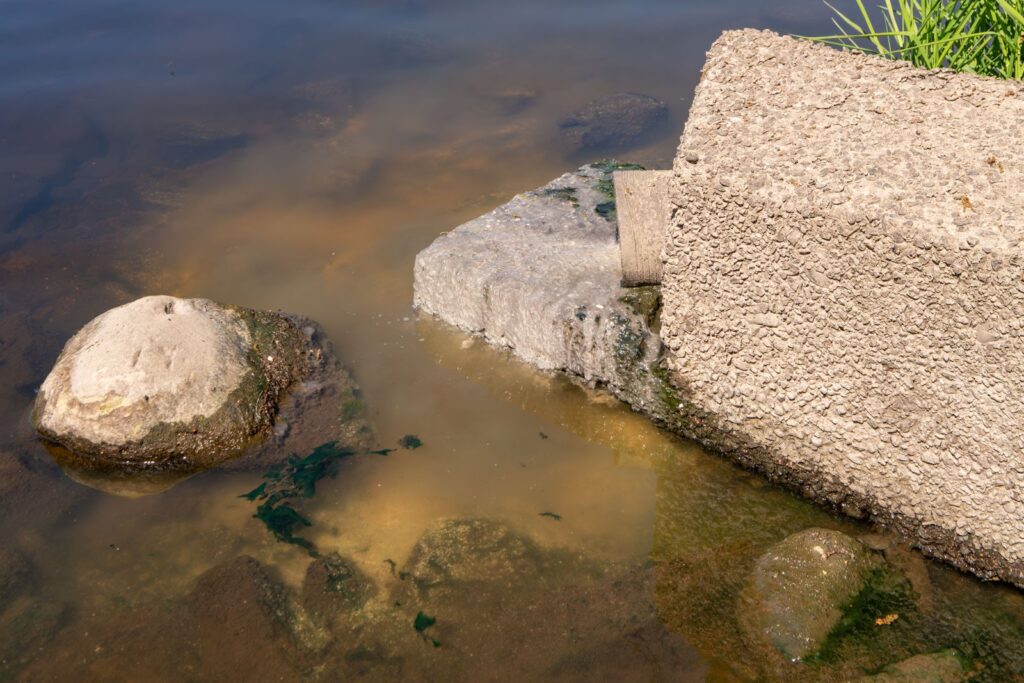
Sewage pollution in the River Dee
There are three main effluent discharges on the River Dee around the Old Bridge of Dee. One from the Castle Douglas town WWTW (Sewage Works), the Rhonehouse village septic tank and the Bridge of Dee Village septic tank, all managed by Scottish Water.
During the dry spring and summer of 2025, the water level in the River Dee by the Old Bridge of Dee was very low with minimal flow. I observed a very pronounced plume of effluent discharging from the Bridge of Dee Village septic tank outlet, which was fully exposed above water level. I also observed effluent discharging from the Rhonehouse Village septic tank outlet, which was also above water level. Concerned about the river and its users, I contacted the Environmental Rights Centre of Scotland (ERCS) for advice.
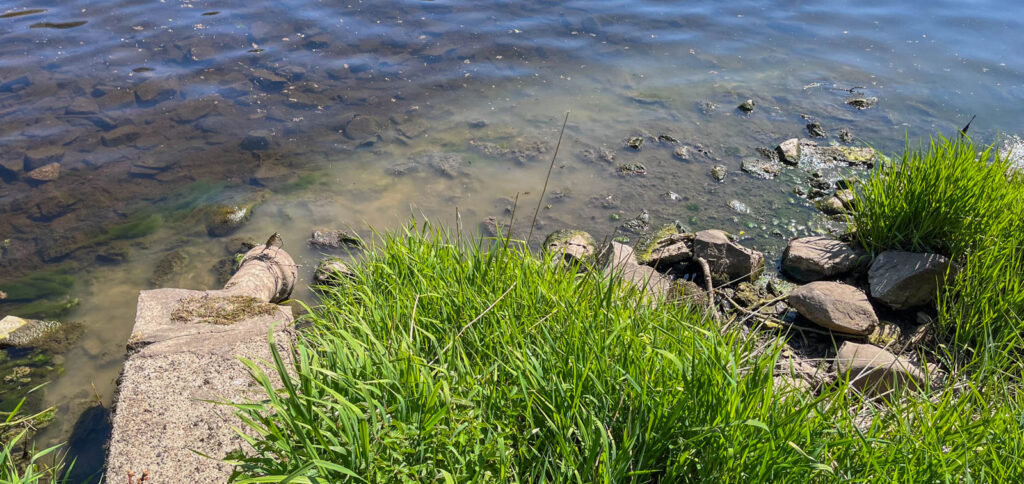
Taking action on water pollution
With support and advice from ERCS, I took the following actions.
Contacting SEPA
In contacting SEPA, I learnt that they do not monitor Scottish Water’s Rhonehouse or Bridge of Dee Village septic tank discharges, as it is apparently not their policy to monitor septic tanks of relatively small capacity.
SEPA said that they rely on the dilution effect of high river levels and flow rates to mitigate any potential adverse effects of septic tank discharges, however in dry periods with low river levels and flow rates, this seems unlikely to be achieved.
SEPA suggested that recreational water users should undertake their own risk assessments, however, this seems highly unlikely for children wanting to swim. Furthermore, there is no signage to warn new and even regular users of the presence of effluent and the potential health hazards, which I have only recently become aware of.
Contacting Dumfries & Galloway Council
In contacting the Council, I established that anyone living in Dumfries and Galloway has the right to make statutory nuisance complaints to the Council’s Environmental Health Team about pollution from the Rhonehouse and Bridge of Dee septic tank discharges as a matter likely to be prejudicial to health. I submitted a complaint, which was not upheld but following a Stage 1 complaint with support from ERCS, the Environmental Health Team investigated the pollution. Although they found no pollution at the time of investigation, they intended to investigate for pollution following periods of low rain and low river levels.
Contacting residents living near the septic tank discharge outlets
I learnt from the residents that the Rhonehouse septic tank discharge has been the subject of complaints for many years. Odour from the Bridge of Dee septic tank discharge outlet has at times been experienced in a resident’s garden and even inside the property.
During the school summer holidays, a resident spotted bicycles lying on the riverbank and found children near the Rhonehouse Village septic tank outlet looking for a place to swim. The resident drew their attention to the septic tank outlet location and advised them against swimming there.
What needs to change
In the short term, for all septic tanks that discharge into water courses, irrespective of their size & capacity, I would like to see SEPA:
1) Undertake mandatory annual inspection and testing of the discharge to ensure full compliance with their respective CAR (Controlled Activity Regulations) licence conditions (now Environmental Authorisation Scotland Regulation (EASR) permit); and take any enforcement action required.
2) Clearly record and publicise all legacy / old septic tanks that do not meet SEPA’s current standards.
3) Publicise the National Grid Reference location of every discharge so that recreational water users and the general public can be better informed of potential hazards.
For Scottish Water to:
1) Accurately identify and record the types and number of properties, including the number of residents, that discharge to each of their septic tanks so that SEPA can accurately validate their design adequacy and capacity against their respective SEPA CAR licences.
In the long term, I would like to see:
1) The prohibition of all septic tank discharges directly to water courses, as has already occurred in England.
2) Improvements to WWTWs (sewage works) and sewage systems so that during periods of heavy rainfall, combined sewer systems are far less likely to discharge directly into water courses.”
Written by G, a client of ERCS’s law service
[1] UK Government (website accessed 12 March 2026) General binding rules: small sewage discharge to the ground