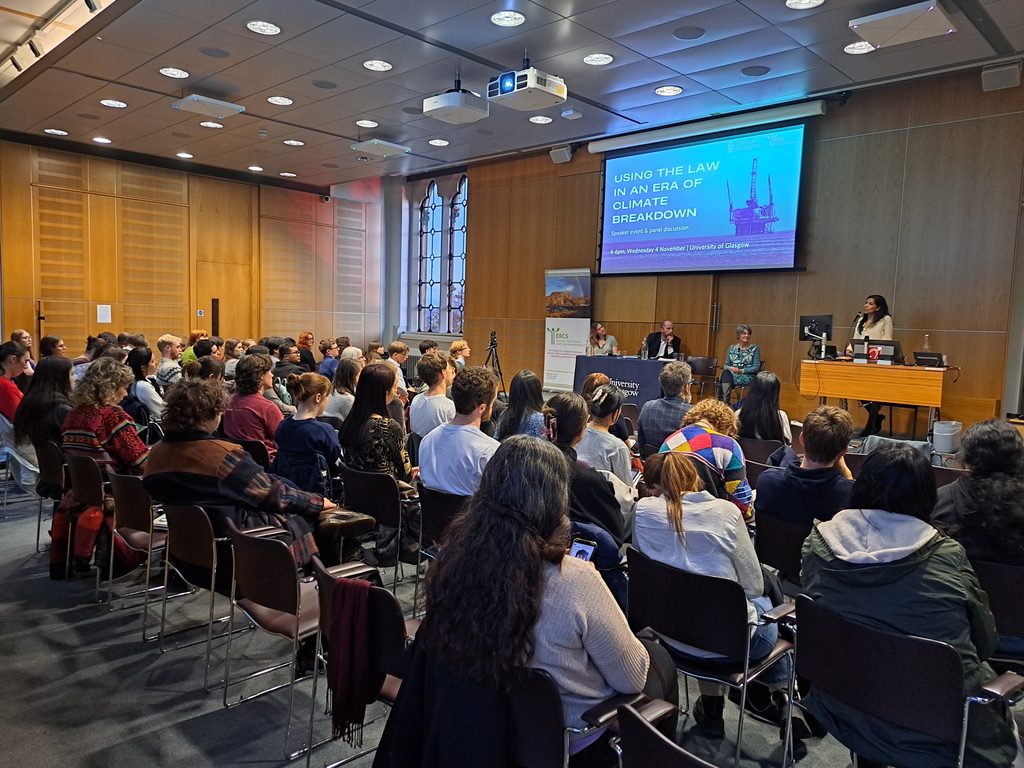
At the beginning of November, ERCS teamed up with the University of Glasgow Law School to co-host a packed-out speaker event with experts in environmental law and practitioners of climate litigation. The event, ‘Using the law in an era of climate breakdown,’ aimed to contributed to the dialogue sparked by our Fossil Free Law student network, which seeks to catalyse a culture shift in Scotland’s next generation of lawyers and ensure that the fight for a living planet is at the heart of the Scotland’s legal profession, not just an afterthought.
We heard excellent contributions from our guest speakers Sarah Finch and Tessa Khan. Sarah Finch, climate campaigner and recipient of the Goldman environmental prize, spoke eloquently about her experience as a litigant taking the UK Government to court on behalf of the WEALD action group over national climate policy. Her case went all the way to the UK Supreme Court, which ruled in her favour that before drilling for new oil or gas, developers must assess the harm that will be caused by the burning of those fuels.
The landmark ‘Finch ruling,’ has had far reaching ramifications in preventing the approval of other fossil fuel projects and set a precedent in how ‘downstream emissions’ (i.e. from burning of fossil fuels) are accounted for in environmental impact assessment processes.
Tessa Khan, lawyer and executive director of Uplift, spoke about her professional journey, from working as an international lawyer and UN advisor to climate advocacy, highlighting the limits of international legal processes in resolving conflicts that are fundamentally about who holds political and economic power.
Uplift was a petitioner in the successful judicial review against the UK Government’s decision to approve permits for drilling from the Jackdaw and Rosebank oil and gas fields in the North Sea. In her talk, Tessa expertly dismantled the arguments for developing Rosebank, which if approved would generate 254 million tonnes of CO₂ equivalent, equal to 70% of the UK’s entire annual emissions.
Ben Christman, ERCS Legal Director, highlighted our recent casework around hyperscale data centres, which consume vast amounts of power (often relying on backup gas or diesel generators) and could blow a hole in progress towards Scotland’s net zero targets.
Ben highlighted our recent win securing mandatory environmental impact assessment for all projects over 50 MW, and the Scottish Government’s commitment to publish new planning guidance on ‘green data centres’, demonstrating how concerted legal and political pressure can generate policy shifts and redraw decision-making processes. Ben also highlighted the need to move from ‘climate conscious’ to ‘climate justice’ lawyering, matching awareness with action that meets the challenges of our political moment.
The event concluded with reflections from Sandy Malcolm, Ethan Cooper, and Layla Vansoh from the Fossil Free Law student steering group, who connected the speeches with the campaign’s ongoing effort to strengthen climate change guidance for solicitors in Scotland and integrate climate justice into the law curriculum. They delivered an emphatic call for the broader legal profession take a principled stance consistent with our climate commitments, and for lawyers to decline to advise on polluting fossil fuel projects.
The evening was moderated by our excellent host Giedre Jokubauskaite, Professor of Law and Sustainability at University of Glasgow School of Law. We thank Giedre and Becca from the University of Glasgow’s Just Transition Research Cluster for co-organising the event, our funders and the Festival of Social Science for making the event possible.
For more info check out our Fossil Free Law campaign.