Written by Mandy Cairns, Communities against woodsmoke
Contact: communitiesagainstwoodsmoke@gmail.com
Solid fuel burning, in particular wood burning, is rising across the UK[1], with Scotland’s burning prevalence increasing.[2] This is causing a rise in air pollution. The majority of wood burning is being carried out by more affluent people as a lifestyle choice for aesthetic purposes rather than out of necessity or fuel poverty.[3]
Research assessing the health impacts of domestic solid fuel and wood burning in Scotland showed that this was mainly an urban issue and the areas most affected were across the Central Belt, in particular Fife, Falkirk, Clackmannanshire, City of Edinburgh, North and South Lanarkshire and Stirling.[4] In addition, many holiday homes, Airbnbs and glamping pods are installing wood burning stoves and seaside wood burning saunas are now popping up all around the coast.
Wood burning – the harm to human health
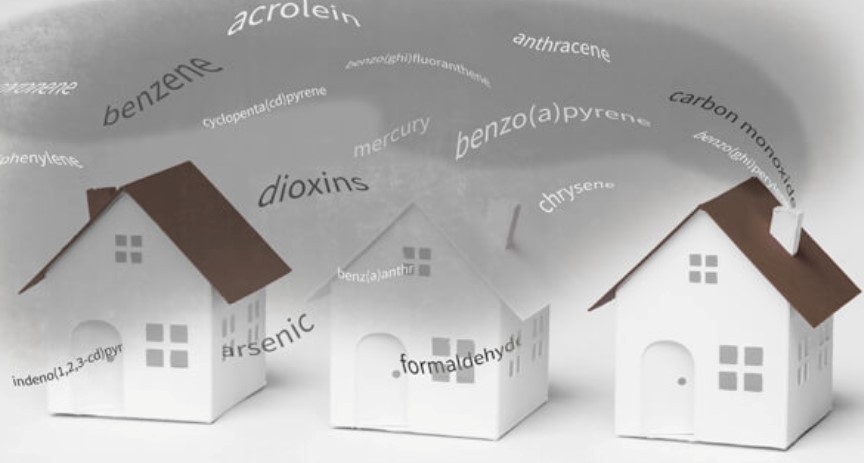
The problem with this increase in wood burning lies in the chemical pollutants that are being released into the air outside and inside of homes. Homes with wood burning stoves are 3 times more polluted than those without.[5]
Most of the pollutants, such as PM0.1[1] and PM2.5[2] are particles so small that they are invisible to the naked eye and evade our body’s natural defences. These particles can enter the homes of people not using a solid fuel appliance, meaning everyone in a neighbourhood is at risk of exposure to these toxins. Once they are in the body, they can cause lasting damage.
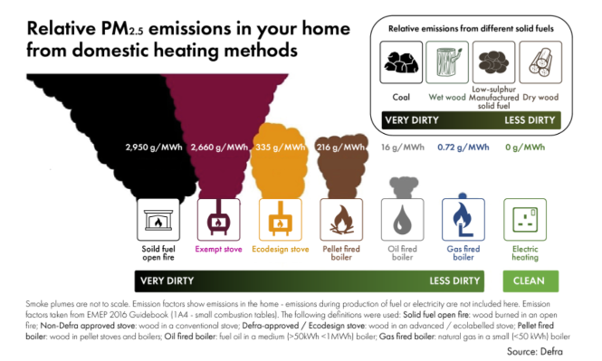
27% of the primary PM2.5 pollution in the UK is now coming from burning solid fuel (three quarters of which is wood). This is nearly two times that from road transport.[6] Ecodesign stoves, whilst producing less PM2.5 than an open fire still produces around 450 times more PM2.5 than a gas boiler.[7] Some newer model stoves, while producing less PM 2.5, produce more PM0.1, which can be more toxic.[8]
The pollutants released when wood (dry or wet) is burnt are linked to many diseases including dementia, cancer, Parkinsons disease and heart and lung diseases, alongside the more obvious illnesses such as asthma and Chronic Obstructive Pulmonary Disease (COPD).[9]
The Royal College of Physicians in Edinburgh[10] and the Royal College of Paediatrics and Child Health[11] have all called on Governments to phase out domestic wood burning because of the harm to health.
Only 1% of occupied dwellings in Scotland use solid fuel burning as their main heating source. The other 99% have an alternative main heating source that is gas, oil or electric.[12] This means the problem of pollution from solid fuel burning is largely avoidable.
The environmental harms of wood burning
Wood is not a carbon neutral fuel. For the same amount of heat or energy, burning wood releases more carbon dioxide (CO2) than oil or gas.[13] When wood is burnt, carbon stored for decades is suddenly released back into the air, so wood burning is not truly carbon neutral or 100% eco-friendly.
It can take decades for trees to regrow and reabsorb the carbon emitted by burning wood. A substantial number of newly planted trees succumb to disease, predation, droughts or fire.[14]
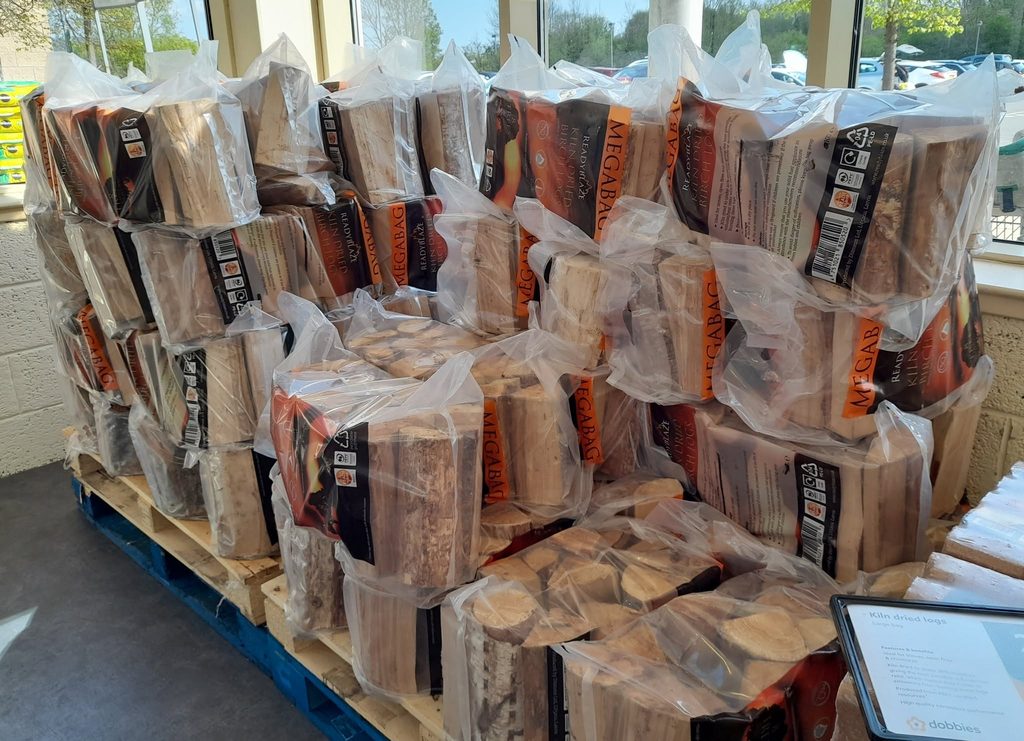
From our investigations, we discovered that some logs available for burning on sale in shops in Scotland are imported from Eastern Europe, increasing the carbon footprint of wood burning even more.
Over the last 24 years, Scotland has lost 400,000 hectares of tree cover.[15] According to the latest State of Nature report 2023, woodland bird numbers have reduced in abundance by 15% in just the past five years. Many species of birds, insects, fungi and bacteria that form essential ecosystems are at least partially dependent on dead wood.[16] Removing this dead wood to burn is damaging this fragile ecosystem, leading to a decline in insect numbers and other wildlife. Cutting down trees for fuel destroys forests, damages ecosystems and leads to biodiversity loss.
Communities against woodsmoke campaign
We are a grassroots volunteer-led campaign group that seeks to educate and inform the public and politicians of the health and environmental harm caused by woodsmoke and to campaign for legislation around this issue so that everyone can have the right to breathe clean air.
We have been gathering the experiences of people around Scotland who are being affected by woodsmoke and we have been meeting with MSPs and local authorities. We regularly take part in #CleanAirNight, which falls every year in November, by holding various talks around the country and information stalls in town centres and libraries.
We have made a short video explaining this source of pollution and have told people’s stories of the effects of it.
We hope to continue to collect the experiences of people around Scotland impacted by this pollution and we are calling for a public awareness campaign on the harm to health and the environment of wood burning.
We want people who are burning out of necessity due to fuel poverty to be offered the same right to breathe clean air as everyone else and will campaign for them to get the financial and other support needed to transition to cleaner forms of heating.
This blog was written by an ERCS supporter and we welcome writers to share their thoughts and engage in debate on all aspects of environmental rights. The views expressed are theirs alone and do not necessarily reflect ERCS’s position. ERCS is not responsible for the accuracy of any information supplied.
[1] Particulate matter with a diameter less than 100 nanometres.
[2] Particulate Matter with a diameter of 2.5 micrometres or less.
[1] University College London (2025) Where are the wood burners in England and Wales?
[2] Scottish Government (2026) Domestic solid fuel burning – effects of PM2.5 on health outcomes: evaluation
[3] Sally Howard (2025) Domestic wood burners kill thousands and cost NHS millions a year, report suggests, BMJ 391:r2257
[4] Scottish Government (2026) Domestic solid fuel burning – effects of PM2.5 on health outcomes: evaluation
[5] UK Government (2022) Chief Medical Officer’s annual report 2022: air pollution
[6] Fuller (2023) Wood (and solid fuel) burning in the UK- a new challenge from an old problem
[7] UK Government (2022) Chief Medical Officer’s annual report 2022: air pollution
[8] Kuye (2025) Particulate matter exposure from different heating stoves and fuels in UK homes, Sci Rep 15 21394
[9] Doctors and Scientists Against Wood Smoke Pollution (accessed 15 October 2026) Wood smoke and health
[10] Belch (2026) Royal College of Physicians of Edinburgh stands against the wood burning lobby, BMJ 393 :e346921
[11] Royal College of Paediatrics and Child Health (accessed 27 October 2026) Air pollution in the UK – position statement
[12] Scottish Government (2025) Scottish House Condition Survey: 2023 Key Findings
[13] Sterman (2022) Does wood bioenergy help or harm the climate?, Bulletin of the Atomic Scientists 78(3) 128–138
[14] Natural World Fund (2026) UK Tree Planting Targets at Risk as Drought Kills Millions of Saplings
[15] Global Nature Watch (accessed 27 October 2026) Dashboard