Over the last 18 months, ERCS have been working closely with Inclusion Scotland and the Sensing Climate project to identify opportunities for disability-inclusive climate emergency planning in Scotland.
We are excited to be launching the findings of this work at a roundtable event in Edinburgh on Friday 19 June. The event will bring together climate adaptation policy and resilience practitioners and decision-makers, with disabled people and disabled people’s organisations, to identify opportunities to progress disability-inclusive climate emergency planning in Scotland.
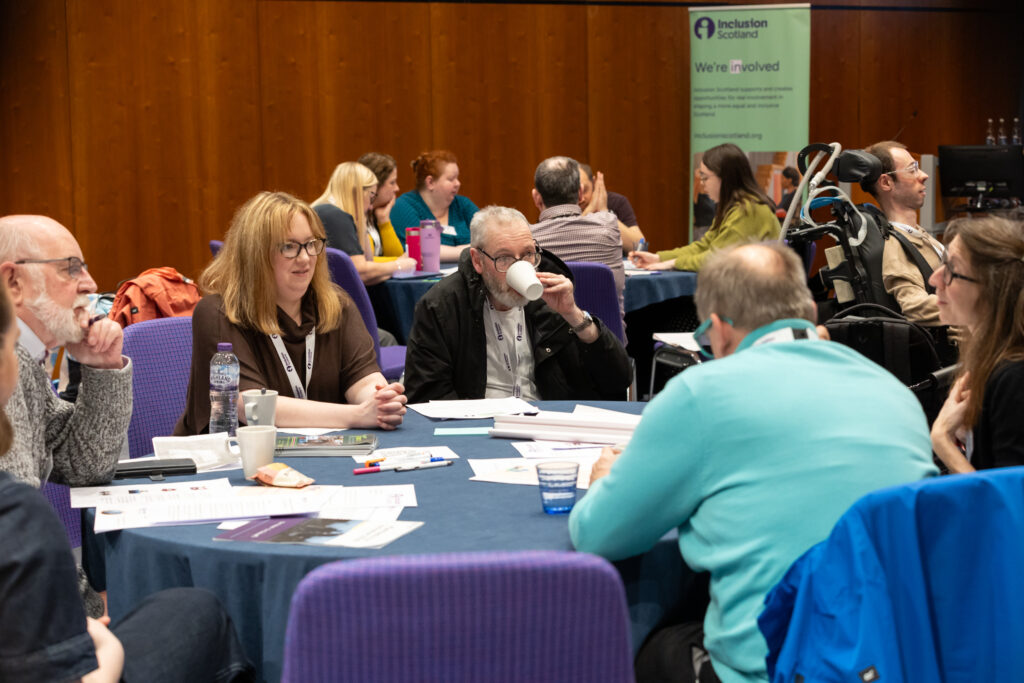
by David Mollison
The report
Globally, climate change is intensifying and increasing the frequency of extreme weather events worldwide. In Scotland, the Scottish Environmental Protection Agency (SEPA) issued a record number of flood alerts and warnings during the winter of 2024.
Disabled people make up 26% of the Scottish population and are disproportionately impacted by climate change because of intersecting forms of discrimination and marginalisation. It is crucial to understand that this heightened risk is not due to an innate ‘vulnerability’ but rather a result of societal perceptions, priorities, decisions, policies and practices that place disabled people at a disadvantage.
Through both a policy analysis and a workshop with disabled people in Scotland, we have developed a report that reflects on the extent to which Scotland’s emergency planning policies are disability-inclusive and identifies recommendations for disability-inclusive climate emergency planning. By disability-inclusive, we refer to policies that are co-designed by disabled people, informed by their priorities and include tangible actions to reduce the risks for them.
The report proposes a six-step model to assess the inclusivity of Scotland’s national and local policies, reviews Scotland’s key climate change policies linked to emergency planning in relation to this model, summarises discussions held during a workshop with disabled people to identify key priorities for disability inclusive emergency planning, and sets out key recommendations for future work in this area.
The report is available to download in three different formats:
Key recommendations
- Identify what disaggregated data is available and what additional data needs to be collected and safeguarded regarding disabled people’s needs and priorities for emergency planning.
- Use inclusive language and recognise disabled people as critical stakeholders with valuable knowledge for building adaptive capacity, rather than as ‘inevitably vulnerable’ or ‘passive recipients’ of assistance.
- Create the enabling conditions for the expertise of disabled communities to inform the development and review of climate and emergency planning policies.
- Ensure that Disabled People’s Organisations are resourced to build the awareness and capacity of disabled people for emergency planning.
- Ensure that all emergency planning is inclusive and accessible by providing adequate training and capacity building, including resourcing Disabled People’s Organisations to be involved in training and feedback across the multiple actors involved: from emergency responders through to community resilience groups and housing associations.
- Ensure emergency planning information is accessible, relevant and easy to find. This is particularly important for understanding climate risks, early warning information, and preparing for emergencies.

Discussion table 2 at the lived experience workshop for disability-inclusive climate emergency planning
by David Mollison
Find out more
If you would like to find out more about this work and/or the upcoming roundtable event, do get in touch:
- Sarah, Sensing Climate, sarah.bell@exeter.ac.uk
- Shivali, Environmental Rights Centre for Scotland, sfifield@ercs.scot
- Maia, Inclusion Scotland, Maia@inclusionscotland.org
Acknowledgements
We give a special thanks to the participants of the lived experience workshop who informed this work: Derek Kelter, Elaine Paterson, Kim Dams, Gautam Kumar Chaudhury, Gordon Yuill, Calum Grevers, Derek Todd, Peter McDade and Ian Jubb.
Sensing Climate would also like to acknowledge everyone who has contributed their time and energy to taking part in the Sensing Climate research, and UK Research and Innovation (UKRI) for funding this study under the UK government’s Horizon Europe funding guarantee [grant number EP/Y004264/1].